Choose by skill · Numbers
From counting a group to seeing how numbers fit together.
Choose free number worksheets and maths games for counting, tens and ones, comparing, number bonds to 10 and subtraction. Practical starting points and PDFs.
Find a starting point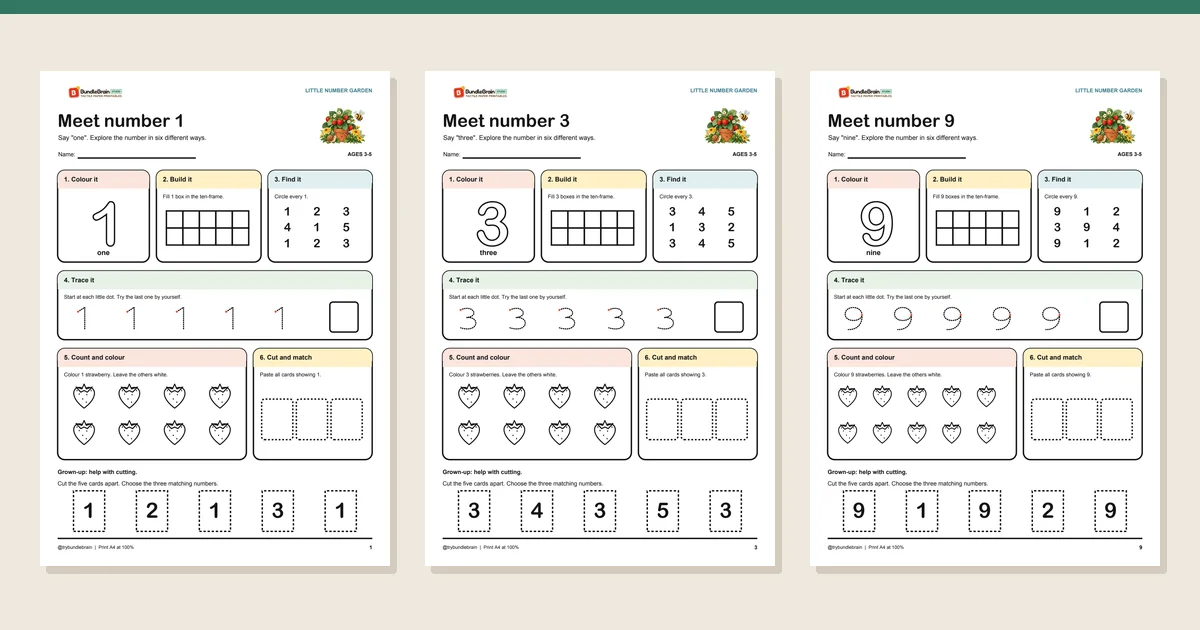
Saying the number sequence, matching one object to each count and understanding the total are different things to practise. Start with a small group your child can count accurately, then choose the next task below. There is no need to move into written sums just because a counting page is finished.
The same printable can support different answers: point, move a counter, say the amount or write a numeral. Use the option that lets the child think about the maths without making pencil control the main hurdle. Every resource page shows its starting skills, materials and actual PDF previews.
Start where your child is
What would you like to practise?
Connect a numeral with a small quantity
Choose one numeral from 1 to 9 and connect it with the page's pictures and ten-frame. Move slowly through a few items rather than racing through the whole pack as fast as the demonstration video.
Little Number Garden: numbers 1–910-page A4 PDF · Suggested ages 3–5 · Free, no sign-up
Include zero and practise counting again
Match number cards and quantities from 0 to 9 with the feeding activity. Talk about zero as no items in that group, not as a missing instruction.
Feed the Number Monsters 0–913-page A4 PDF · Suggested ages 4–6 · Free, no sign-up
Talk about flat shapes
Start with circle, square and triangle, then add shapes when useful. The 12-shape set offers extensions; a child does not need all 12 names before enjoying a finding or matching task.
Little Shape Detectives14-page A4 PDF · Suggested ages 3–7 · Free, no sign-up
See a ten and some more
Use tens and ones representations for 11–20 once small-quantity counting is comfortable. Compare the complete ten with the extra ones before writing the number.
Build Numbers 11–2016-page A4 PDF · Suggested ages 5–7 · Free, no sign-up
Split a whole and find a missing part
Move the supplied counters between two parts of the mat. Focus pages cover wholes from 2 to 10, with mixed reviews and answers. Start with a smaller whole before choosing 10.
Number Bond Workshop 2–1015-page A4 PDF · Suggested ages 5–7 · Free, no sign-up
Compare two quantities
Count and compare the groups before adding <, > or =. Explain which group has more, fewer or the same number so the symbol represents a comparison the child understands.
Compare Numbers 1–2016-page A4 PDF · Suggested ages 5–7 · Free, no sign-up
Model addition or subtraction with movement
Use the paper frog and number path to show one space per hop. Model the starting number and direction before expecting a child to record the answer.
Jump & Solve: three number-path games10-page A4 PDF · Suggested ages 5–7 · Free, no sign-up
Show subtraction by removing objects
Practise taking away within 10 using the pack's representations. Count what remains and connect the action with the written subtraction, rather than only memorising the finished equation.
Take Away Lab: subtraction within 1017-page A4 PDF · Suggested ages 5–7 · Free, no sign-up
Keep it manageable
A small practice session
- 1
Build the amount first
Use the pack's pictures or counters to show a small whole. Count each item once and ask how many there are altogether. Reduce the amount or model again if the count becomes a guessing game.
- 2
Change one thing and describe it
Split the group, add an item, remove an item or compare it with another group. Ask what changed. On a number bond mat, keep the whole fixed while moving items between the two parts.
- 3
Connect the action to the page
Point to or write the matching numeral or equation. In a later turn, let your child build a different example and explain it. Keep the task short enough that you can notice their reasoning, not just whether a box is filled.
Questions before choosing
Do you have number bonds to 10 with answers?
Yes. Number Bond Workshop covers each whole from 2 through 10 and includes mixed reviews, a reusable part–whole mat, counters, challenge cards and answers in a 15-page A4 PDF.
Which pack should we choose if writing numbers is tiring?
Use pointing, quantity matching or moving counters in a counting or number bond activity. A grown-up can record the answer. Choosing a non-writing response keeps the task focused on the number idea.
Are the fast maths videos the pace for a child?
No. They demonstrate what the pieces and pages can do. Pause, model a turn and give your child time to count or explain. Print selected pages rather than turning the whole PDF into one session.
Further reading for grown-ups
EEF: Improving Mathematics in the Early Years and Key Stage 1
Evidence guidance for adults working with ages 3–7, including maths in everyday activities and number board games. Read it for ideas beyond a worksheet session.